开发设计模式设计模式:01-单例模式
kikock1、基本介绍
所谓类的单例设计模式,就是采取一定的方法保证在整个的软件系统中,对某个类只能存在一个对象实例,并且该类只提供一个去的其对象实例的方法(静态方法)。
比如 Hibernate 的 SessionFactory,它充当数据存储源的代理,并负责创建 Session 对象。SessionFactory 并不是轻量级的,一般情况下,一个项目通常只需要一个 SessionFactory 就够,这是就会使用到单例模式。
2、单例模式的使用方式
单例模式有八种方式:
1)[饿汉式(静态常量)]
2)[饿汉式(静态代码块)]
3)[懒汉式(线程不安全)]
4)[懒汉式(线程安全,同步方法)]
5)[懒汉式(线程安全,同步代码块)]
6)[双重检查]
7)[静态内部类]
8)[枚举]
3、饿汉式(静态常量)
3.1 应用实例
步骤如下:
1)构造器私有化(防止 new)
2)类的内部创建对象
3)向外暴露一个静态的公共方法。getInstance
4)代码实现
1
2
3
4
5
6
7
8
9
10
11
12
13
14
15
16
17
18
19
20
21
22
23
24
25
26
27
28
29
30
31
32
33
34
35
| package com.wenze.design.singleton.hungryStaticConstant;
public class SingletonTest {
public static void main(String[] args) {
final Singleton instance1 = Singleton.getInstance();
final Singleton instance2 = Singleton.getInstance();
System.out.println(instance1 == instance2);
System.out.println("instance1.hashCode() = " + instance1.hashCode());
System.out.println("instance2.hashCode() = " + instance2.hashCode());
}
}
class Singleton {
private final static Singleton INSTANCE = new Singleton();
public static Singleton getInstance() {
return INSTANCE;
}
}
|
3.2 优缺点说明
1)优点:这种写法比较简单,就是在类装载的时候就完成实例化。避免了线程同步问题。
2)缺点:在类装载的时候就完成实例化,没有达到 Lazy Loading 的效果。如果从始至终从未使用过这个实例,这会造成内存的浪费。
3)这种方式基于 classloader 机制避免了多线程的同步问题,不过,instance 在类装载时就实例化,在单例模式中大多数都是调用 getInstance 方法,但是导致类装载的原因有很多种,因此不能确定有其他方式(或者其他的静态方法)导致类装载,这时候初始化 instance 就没有达到 Lazy Loading 的效果。
4)结论:这种单例模式可用,可能造成内存浪费
4、饿汉式(静态代码块)
4.1 应用实例
代码实现:
1
2
3
4
5
6
7
8
9
10
11
12
13
14
15
16
17
18
19
20
21
22
23
24
25
26
27
28
29
30
31
32
33
34
35
36
37
38
| package com.wenze.design.singleton.hungryStaticCodeBlock;
public class SingletonTest {
public static void main(String[] args) {
Singleton instance1 = Singleton.getInstance();
Singleton instance2 = Singleton.getInstance();
System.out.println(instance1 == instance2);
System.out.println("instance1.hashCode=" + instance1.hashCode());
System.out.println("instance2.hashCode=" + instance2.hashCode());
}
}
class Singleton {
private Singleton() {}
private final static Singleton INSTANCE;
static {
INSTANCE = new Singleton();
}
public static Singleton getInstance() {
return INSTANCE;
}
}
|
4.2 优缺点说明
1)这种方式和上面的方式其实类似,只不过将实例化的过程放在了静态代码块中,也是在类装载的时候,就执行静态代码块中的代码,初始化类的实例。优缺点和上面是一样的。
2)结论:这种单例模式可用,但是可能造成内存浪费。
5、懒汉式(线程不安全)
5.1 应用实例
代码实现:
1
2
3
4
5
6
7
8
9
10
11
12
13
14
15
16
17
18
19
20
21
22
23
24
25
26
27
28
29
30
31
32
33
34
35
| package com.wenze.design.singleton.lazyThreadNotSafe;
public class SingletonTest {
public static void main(String[] args) {
System.out.println("懒汉式1,线程不安全~");
final Singleton instance1 = Singleton.getInstance();
final Singleton instance2 = Singleton.getInstance();
System.out.println(instance1 == instance2);
System.out.println("instance1.hashCode=" + instance1.hashCode());
System.out.println("instance2.hashCode=" + instance2.hashCode());
}
}
class Singleton {
private static Singleton instance;
private Singleton() {
}
public static Singleton getInstance() {
if (null == instance) {
instance = new Singleton();
}
return instance;
}
}
|
5.2 优缺点说明
1)起到了 Lazy Loading 的效果,但是只能在单线程下使用。
2)如果在多线程下,一个线程进入了 if (null == singleton) 判断语句块,还未来得及往下执行,另一个线程也通过了这个判断语句,这时便会产生多个实例,所以,在多线程环境下不可使用这种方式。
3)结论:在实际开发中,不要使用这种方式。
6、懒汉式(线程安全,同步方法)
6.1 应用实例
代码实现:
1
2
3
4
5
6
7
8
9
10
11
12
13
14
15
16
17
18
19
20
21
22
23
24
25
26
27
28
29
30
31
32
33
34
| package com.wenze.design.singleton.lazySynchronizedMethod;
public class SingletonTest {
public static void main(String[] args) {
System.out.println("懒汉式,线程安全,同步方法");
Singleton instance1 = Singleton.getInstance();
Singleton instance2 = Singleton.getInstance();
System.out.println(instance1 == instance2);
System.out.println("instance1.hashCode=" + instance1.hashCode());
System.out.println("instance2.hashCode=" + instance2.hashCode());
}
}
class Singleton {
private static Singleton instance;
private Singleton() {}
public static synchronized Singleton getInstance() {
if (null == instance) {
instance = new Singleton();
}
return instance;
}
}
|
6.2 优缺点说明
1)解决了线程不安全问题
2)效率太低了,每个线程都想获得类的实例的时候,执行 getInstance() 方法都要进行同步。而其实这个方法只执行一次实例化代码就够了,后面的想获得该类实例,直接 return 就行了。方法进行同步效率太低。
3)结论:在实际开发中,不推荐使用这种方式。
7、懒汉式(线程安全,同步代码块)
7.1 应用实例
代码实现:
1
2
3
4
5
6
7
8
9
10
11
12
13
14
15
16
17
18
19
20
21
22
23
24
25
26
27
28
29
30
31
32
33
34
35
| package com.wenze.design.singleton.lazySynchronizedBlock;
public class SingletonTest {
public static void main(String[] args) {
Singleton instance1 = Singleton.getInstance();
Singleton instance2 = Singleton.getInstance();
System.out.println(instance1 == instance2);
System.out.println("instance1.hashCode=" + instance1.hashCode());
System.out.println("instance2.hashCode=" + instance2.hashCode());
}
}
class Singleton {
private static Singleton instance;
private Singleton() {}
public static Singleton getInstance() {
if (null == instance) {
synchronized (Singleton.class) {
instance = new Singleton();
}
}
return instance;
}
}
|
7.2 优缺点说明
1)这种方式,本意是相对第四种实现方式的改进,因为前面同步方法效率太低,改为同步产生实例化的代码块
2)**但是这种同步并不能起到线程同步的作用。**跟第 3 种实现方式遇到的情形一致,加入一个线程进入了 if(singleton == null) 判断语句块,还未来得及往下执行,另一个线程也通过了这个判断语句,这时便会产生多个实例。
3)结论:在实际开发中,不能使用这种方式。
8、双重检查
8.1 应用实例
代码实现:
1
2
3
4
5
6
7
8
9
10
11
12
13
14
15
16
17
18
19
20
21
22
23
24
25
26
27
28
29
30
31
32
33
34
35
36
| package com.wenze.design.singleton.doubleCheck;
public class SingletonTest {
public static void main(String[] args) {
Singleton instance1 = Singleton.getInstance();
Singleton instance2 = Singleton.getInstance();
System.out.println(instance1 == instance2);
System.out.println("instance1.hashCode=" + instance1.hashCode());
System.out.println("instance2.hashCode=" + instance2.hashCode());
}
}
class Singleton {
private static volatile Singleton instance;
private Singleton() {}
public static Singleton getInstance() {
if (null == instance) {
synchronized (Singleton.class) {
if (null == instance) {
instance = new Singleton();
}
}
}
return instance;
}
}
|
8.2 优缺点说明
1)Double-Check 概念是多线程开发中常使用到的,如代码中所示,我们进行了两次 if (singleton = null) 检查,这样就可以保证线程安全了。
2)这样,实例化代码只用执行一次,后面再次访问时,判断 if (singleton = null) ,直接 return 实例化对象,也避免的反复进行方法同步。
3)线程安全;延迟加载;效率较高
4)结论:在实际开发中,推荐使用这种单例设计模式。
9、静态内部类
9.1 应用实例
代码实现:
1
2
3
4
5
6
7
8
9
10
11
12
13
14
15
16
17
18
19
20
21
22
23
24
25
26
27
28
29
30
31
| package com.wenze.design.singleton.staticInnerClass;
public class SingletonTest {
public static void main(String[] args) {
final Singleton instance1 = Singleton.getInstance();
final Singleton instance2 = Singleton.getInstance();
System.out.println(instance1 == instance2);
System.out.println("instance1.hashCode() = " + instance1.hashCode());
System.out.println("instance2.hashCode() = " + instance2.hashCode());
}
}
class Singleton {
private Singleton(){}
private static class SingletonInstance {
private static final Singleton INSTANCE = new Singleton();
}
public static Singleton getInstance() {
return SingletonInstance.INSTANCE;
}
}
|
9.2 优缺点说明
1)这种方式采用了类装载的机制来保证初始化实例时只有一个线程。
2)静态内部类方式在 Singleton 类被装载时并不会立即实例化,而是在需要实例化时,调用 getInstance 方法,才会装在 SingletonInstance 类,从而完成 Singleton 的实例化。
3)类的静态属性只会在第一次加载类的时候初始化,所以在这里,JVM 帮助我们保证了线程的安全性,在类进行初始化时,别的线程是无法进入的。
4)优点:避免了线程不安全,利用静态内部类特点实现延迟加载,效率高
5)结论:推荐使用
10、枚举
10.1 应用实例
代码实现:
1
2
3
4
5
6
7
8
9
10
11
12
13
14
15
16
17
18
19
20
21
22
23
| package com.wenze.design.singleton.enums;
public class SingletonTest {
public static void main(String[] args) {
Singleton instance1 = Singleton.INSTANCE;
Singleton instance2 = Singleton.INSTANCE;
System.out.println(instance1 == instance2);
System.out.println("instance1.hashCode() = " + instance1.hashCode());
System.out.println("instance2.hashCode() = " + instance2.hashCode());
}
}
enum Singleton {
INSTANCE;
}
|
10.2 优缺点说明
1)这借助 JDK1.5 中添加的枚举来实现单例模式。不仅能避免多线程同步问题,而且还能防止反序列化重新创建新的对象。
2)这种方式是 Effective Java 作者 Josh Bloch 提倡的方式
3)结论:推荐使用
11、单例模式在 JDK 应用的源码分析
单例模式在 JDK 应用的源码分析
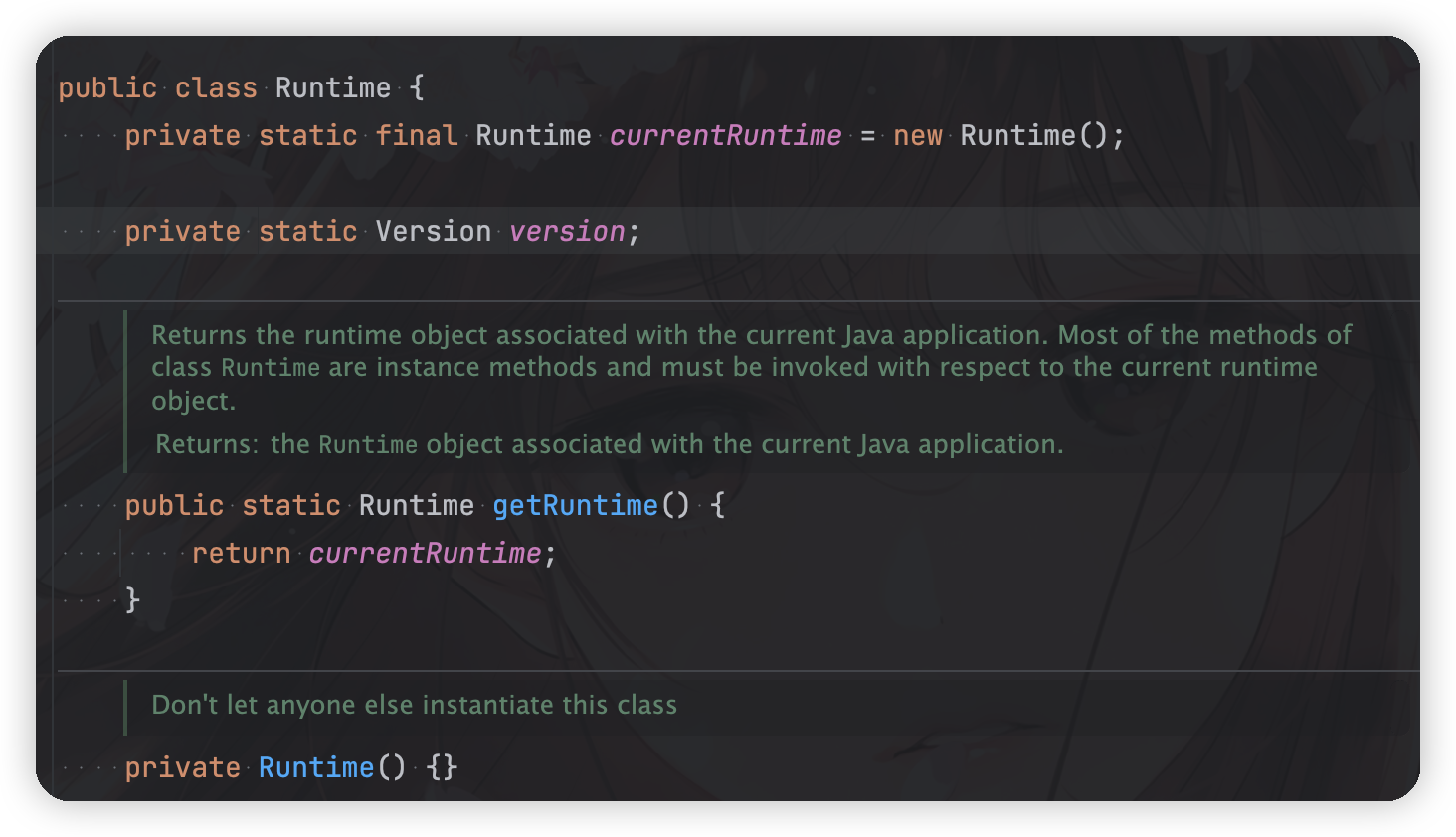
1)我们 JDK 中,java.lang.Runtime 就是经典的单例模式(饿汉式)
2)代码分析 + Debug 源码 + 代码说明

12、单例模式注意事项和细节说明
1)单例模式保证了系统内存中该类只存在一个对象,节省了系统资源,对于一些需要频繁创建销毁的对象,使用单例模式可以提高系统性能。
2)当想实例化一个单例类的时候,必须要记住使用相应的获取对象的方法,而不是使用 new
3)单例模式使用的场景:需要频繁的进行创建和销毁的对象、创建对象时耗时过多或耗费资源过多(即:重量级对象),但又经常用到的对象、工具类对象、频繁访问数据库或文件的对象(比如数据源、session 工厂等)。